What would it take for you to trust an AI agent to make a change to your network?
It is one thing for AI to investigate a problem, correlate evidence, and recommend what an engineer should do next. It is another thing entirely for AI to take the action itself. That’s the transition we see from AI-assisted to autonomous operations, and it changes the role AI plays in NetOps.
In AI-assisted operations, AI helps engineers gather information, understand what is happening, and determine what to do next. In this situation the engineer remains responsible for the decision. Autonomous operations take the next step. AI agents can reason over operational conditions, select an approved course of action, execute it within defined boundaries, and determine whether the action delivered the intended result.
But autonomy can’t simply mean giving an AI agent more access. Before organizations allow agents to change production environments, they need to build confidence that agents have the right operational context, are authorized to take the action, remain within established guardrails, and can validate what happened afterward.
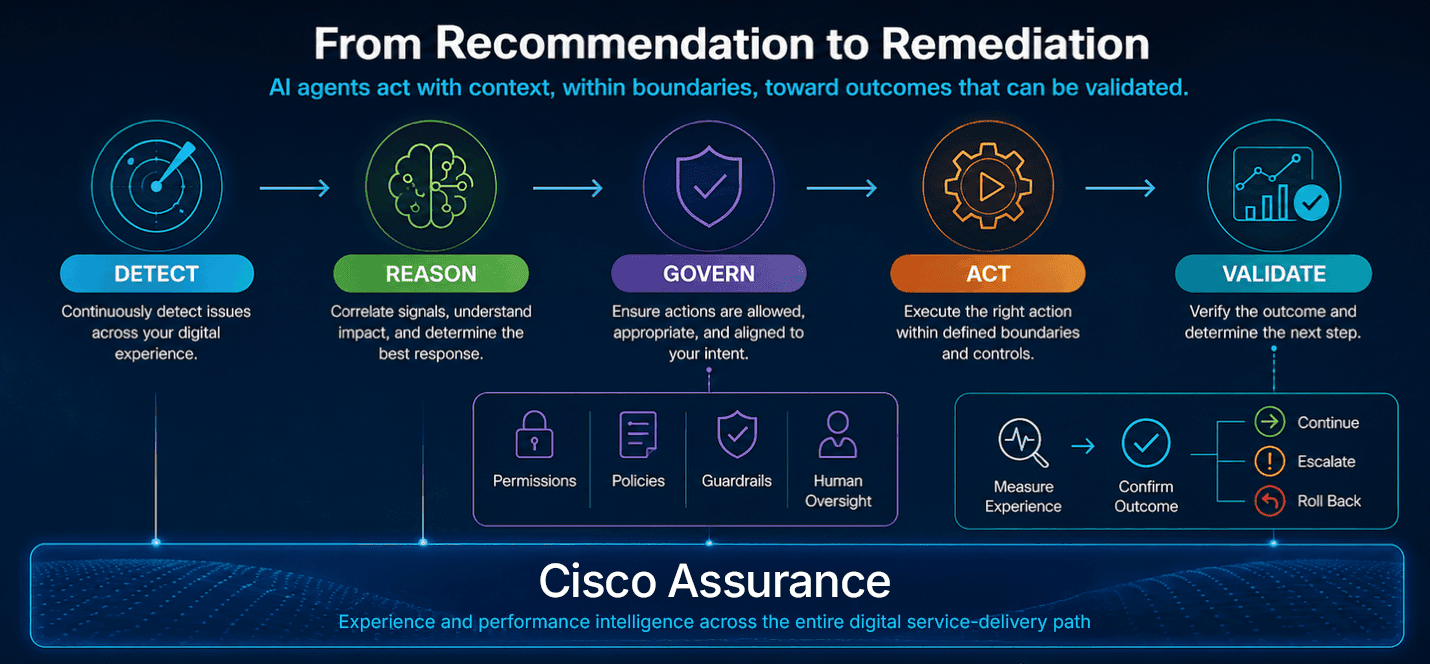
This is where assurance becomes fundamental to autonomous operations. Cisco Assurance provides the experience and performance intelligence agents need to understand operational conditions before acting and determining whether an action improves the experience it was intended to protect.
From Recommendation to Action
Consider this scenario. Users at several branch locations begin experiencing poor application performance. AI investigates the issue, correlates alerts and telemetry, examines relevant network paths, and identifies a common condition that may be contributing to the degradation.
In an AI-assisted model, the workflow might end there. The AI presents its findings, supporting evidence, and a recommended action, and an engineer then reviews the evidence. Flip that. Imagine the condition matches a known remediation. The agent determines that it is authorized to execute the action, makes the change, immediately tests the affected experience, and verifies whether performance returns to the expected state.
The agent is no longer simply helping an engineer understand the problem. It is participating directly in the operational lifecycle.
That shifts the question from “Can AI help me determine what is wrong?” to something much more consequential: “Under what conditions should AI be allowed to do something about it?”
Autonomy Needs Boundaries
Autonomy is often discussed as if it were binary, either a human controls the environment or AI does. Production environments require a much more deliberate approach.
Different actions carry different levels of risk. Gathering diagnostic information is different from modifying a test or configuration. A routine, well-understood remediation is different from a change that could affect routing, security policy, or hundreds of locations. The level of autonomy should reflect those differences.
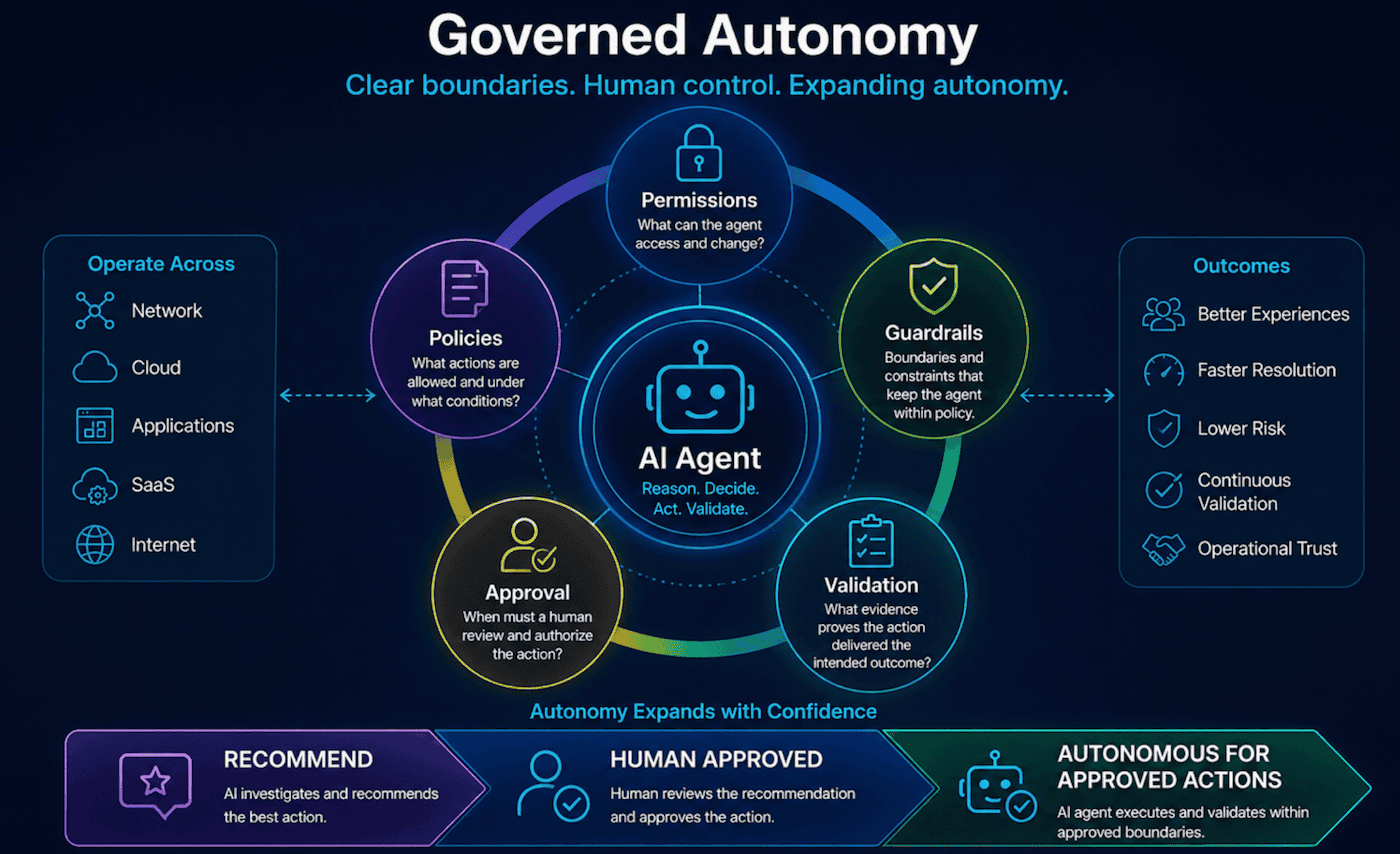
An organization might begin by allowing an agent to investigate and recommend an action while requiring an engineer to approve execution. As confidence grows, specific, well-understood actions can be approved for autonomous execution while higher-risk changes continue to require human authorization.
This creates a progression from recommendation, to approval, to execution, and then to validation, with autonomy expanding as organizations build evidence and confidence that particular actions can be performed safely and reliably.
The controls surrounding the agent are what make that possible:
Identity and permissions - What systems and resources can the agent access?
Policies and guardrails - What actions can it take, and under what conditions?
Human approval - Which actions can execute autonomously, and which require authorization?
Validation - What evidence proves the action delivered the intended result?
Escalation and rollback - What happens when the expected outcome is not achieved?
The important distinction is that autonomy doesn’t have to be granted globally. It can be granted to specific types of actions within clearly defined boundaries and expanded as confidence grows.
This changes the way organizations should think about trust in autonomous operations. The goal is not to trust an AI agent to do anything. It is to establish the conditions under which the agent can be trusted to do something specific.
The Action is Not the Outcome
Successfully executing a change does not mean the problem was solved. Imagine an agent identifies a likely remediation, executes the approved change, and receives confirmation that the command completed successfully. From the perspective of traditional automation, the workflow succeeded.
But what happened to the user?
Did latency improve? Did application performance return to normal? Did the network path stabilize? Did the original condition disappear across all affected locations? Did the change create an unexpected impact somewhere else?
A successful configuration change and a successful operational outcome are not the same thing. This is where assurance changes the autonomous operations model. Instead of treating execution as the end of the workflow, the agent can use assurance intelligence to measure what happened after the action and compare the resulting experience against the expected state.
If experience returns to the expected state, the agent has evidence that the remediation delivered the intended outcome. If it does not, the workflow can gather additional evidence, escalate to an engineer, or initiate a defined rollback when appropriate.
Cisco Assurance provides continuous experience and performance intelligence across the digital service-delivery path. ThousandEyes extends that intelligence across enterprise networks, cloud, SaaS, service providers, and the Internet. For an autonomous agent, that intelligence can provide context before an action and evidence after it.
The distinction is simple:
Before the change: What is happening?
After the change: Did it get better?
Autonomous operations require more than confirmation that a change was executed successfully; agents need assurance that the action improved the experience it was intended to protect.
Close the Loop with Cisco Assurance
Automation has been part of NetOps for years. Scripts, APIs, orchestration platforms, runbooks, and policy engines are highly effective when the inputs, actions, and expected results are known in advance. Agentic operations adds the ability to reason over changing operational conditions, gather additional evidence, and determine which approved response best fits the situation.
The two approaches are complementary. AI can reason about what is happening and determine the appropriate course of action. Automation provides predictable execution. Assurance determines whether the resulting state delivered the expected experience.
Put simply:
AI reasons about the situation.
Automation executes the approved action.
Assurance validates the outcome.
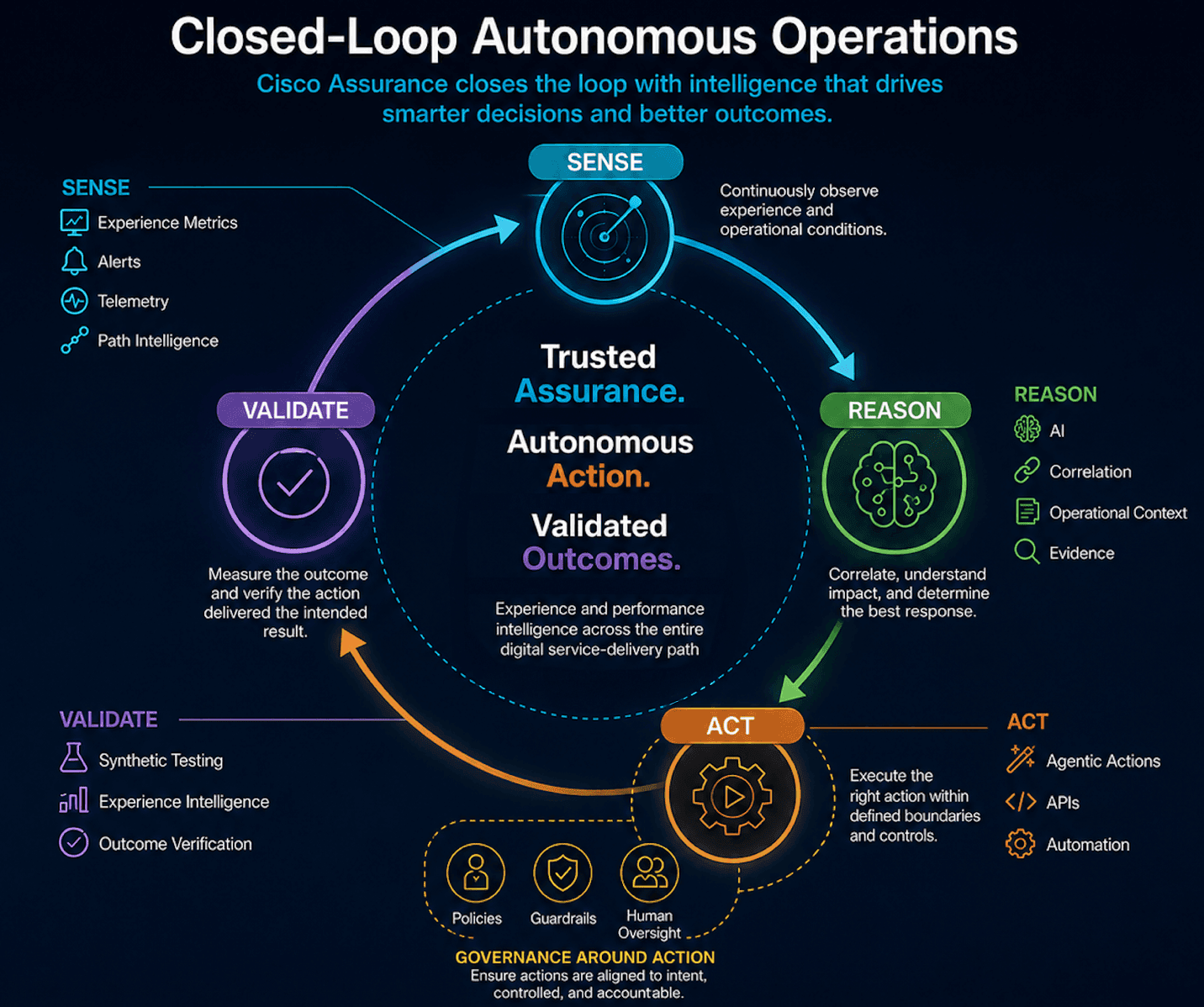
Cisco brings those capabilities together around a closed operational loop.
Experience Metrics continuously measure network and application experience, helping teams and agents understand when meaningful degradation occurs. AI and assurance intelligence provide the context needed to investigate those conditions and determine an appropriate response. Actions connects that intelligence to remediation, allowing actions to progress from recommendations and human-approved execution toward increasingly autonomous workflows governed by policies and guardrails.
Assurance then closes the loop by validating whether the action produced the intended outcome. This is an important shift from traditional automation. Without validation, an autonomous system knows what it did. With assurance, it can determine what its action accomplished.
Autonomy Changes the Role of the Operator
Autonomous operations doesn’t eliminate the network engineer. It changes where human expertise is applied. Today, highly skilled engineers spend significant time gathering data, triaging alerts, moving between systems, executing repetitive actions, and verifying whether those actions worked. As agents take on more of that work, operations can become increasingly human-driven and AI agent-powered, with people defining the intent, boundaries, and desired outcomes while agents handle more of the investigation, execution, and validation.
The operator’s role shifts from performing every task to determining how autonomy should operate. Which actions can execute autonomously and which require approval? What evidence must exist before an action is taken? What defines a successful outcome? When should an agent escalate or roll back a change?
Those decisions build human expertise directly into the policies, guardrails, workflows, and validation criteria that govern AI agents. Humans remain in control of the operating model while agents increasingly execute within it. This creates a more practical definition of autonomous operations: it’s not about AI acting alone, but human-driven operations powered by AI agents that act with context, within defined boundaries, and toward outcomes that can be validated.
And as organizations become more comfortable allowing AI to operate across their environments, the next challenge comes into focus. AI agents are no longer limited to IT operations. They are becoming part of applications, business processes, employee experiences, and customer interactions, and those agents depend on an increasingly complex ecosystem of models, APIs, cloud services, applications, networks, SaaS platforms, service providers, and Internet infrastructure.
That raises the next question, if AI agents increasingly depend on this ecosystem to operate, how do we assure the experience they depend on?
That is the next phase of the journey: Assuring the Agentic Ecosystem.